
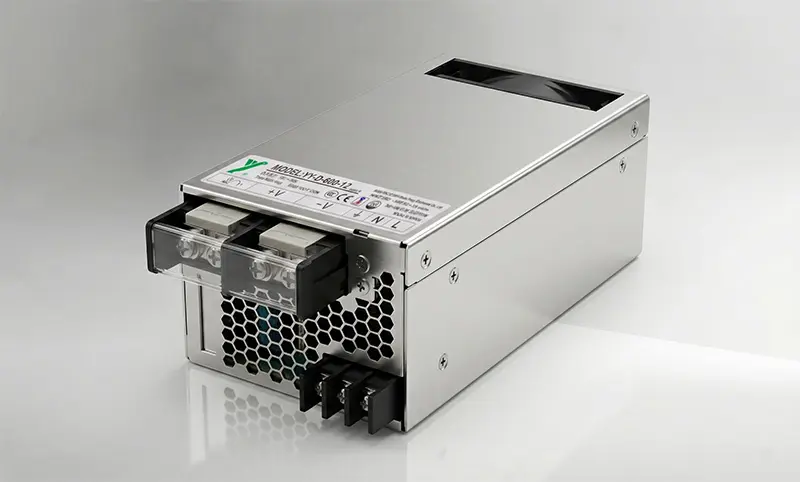
Solution Overview
Smart Control, Transparent Management: A Lithium Battery Charger Solution Based on RS485 Communication
With the widespread adoption of industrial automation, AGVs, and various distributed energy storage devices, lithium batteries, as the core power source, are subject to increasingly stringent requirements for safety and controllability during the charging process. The traditional “blind charging” model — plug-and-charge, stop-when-full — can no longer meet the management demands of modern integrated systems for underlying hardware.
Based on real-world engineering pain points, we have introduced an intelligent lithium battery charger equipped with an RS485 communication interface. This product avoids overly complex concepts; its core purpose is to provide a transparent, manageable, and controllable low-level charging execution unit, fully returning the dispatching authority of the charging process to the system’s master controller.
-
RS485 Communication and Bus Control: Breaking Down Information Silos
Traditional chargers are often standalone “black boxes,” whereas in modern system architectures, all devices need to be connected to a network. This power supply comes standard with an RS485 communication interface, enabling stable and reliable handshaking and communication with a host controller (such as a PLC, industrial PC, or microcontroller). Through host commands, the system can issue “power on” or “power off” instructions to the charger at any time. This means that in multi-device collaboration or unattended scenarios, the master control system can flexibly schedule charging tasks based on grid peak/off-peak conditions, equipment scheduling logic, or safety policies, fully realizing automated closed-loop control. -
Fully Configurable Core Parameters: Flexible Adaptation to Multiple Battery Platforms
Different lithium battery packs (e.g., ternary lithium, lithium iron phosphate) impose strict physical requirements on the charging profile under different operating conditions. If the battery specification is changed, it is often necessary to purchase a different charger model. This communication-enabled charger supports direct setting of core charging parameters via the host controller. Users can dynamically assign the constant current setpoint (maximum charging current), charge cut-off voltage, and specific operating modes according to the actual battery pack connected. This highly customizable design allows the same charger hardware to adapt to lithium battery systems with different voltage platforms, such as 48V, 60V, or 72V, significantly reducing the bill of materials (BOM) and inventory management costs for equipment manufacturers. -
Real-Time Telemetry Data Feedback: Nipping Safety Hazards in the Bud
Safety is always the bottom line for lithium battery charging. In addition to conventional hardware-level protections (overvoltage, overcurrent, short circuit), this charger supports the continuous feedback of critical operational data, such as real-time current and real-time power, to the host controller. The master control system can thereby not only display real-time charging progress to end users on the UI, but more importantly, system algorithms can use this telemetry data to monitor the smoothness of the charging profile and assess the battery’s state of health. Once an abnormal current fluctuation or illogical power output is detected, the host can immediately issue a shutdown command, leveraging dual-redundancy of software and hardware to effectively prevent serious incidents such as thermal runaway.
Conclusion
From the perspective of system integration, an excellent power supply must not only deliver stable and reliable energy output, but also possess excellent “system integrability.” This RS485-equipped charger strips away all flashy gimmicks and uses the most mature standard industrial protocol to provide a pragmatic, efficient, and low-cost hardware-level foundation for intelligent lithium battery charging management.