
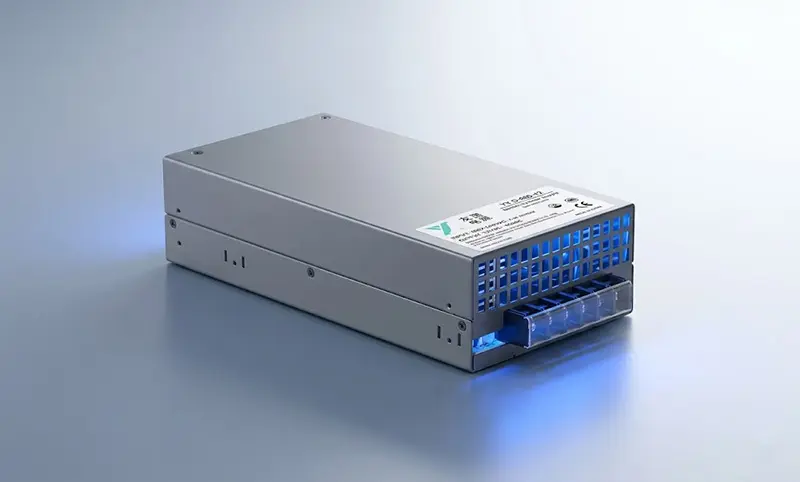
Solution Overview
1. Input Specifications
The grid environment at industrial sites is often complex and unstable, so setting input parameters is critical.
Input Voltage Range: Determine whether it is single-phase (e.g., 85–264 VAC wide range) or three-phase (e.g., 340–550 VAC), and whether DC input is required (e.g., high-voltage DC, HVDC).
Ability to Withstand Grid Fluctuations: Industrial equipment often experiences voltage dips or surges; the transient withstand voltage requirement must be confirmed (e.g., withstand 300 VAC for up to 5 seconds).
Frequency Range: Typically 47–63 Hz; specific industrial or marine/aviation auxiliary equipment may require 400 Hz.
PFC (Power Factor Correction): Is there a mandatory PF requirement (e.g., PF > 0.95 at full load), and harmonic current limits (compliance with EN 61000-3-2)?
Inrush Current: Limited by the capacity of the customer’s upstream circuit breaker (MCB); typically, the cold-start inrush current must be below a specific value.
2. Output Specifications and Load Capability
Industrial loads (such as motors, relays, contactors, servo drives) differ from conventional electronic loads and demand extremely high dynamic and overload performance.
Rated Output Voltage and Adjustment Range: For example, 24 VDC; is a potentiometer fine adjustment (e.g., 22.8–26.4 V) required, or programmable voltage adjustment via external analog voltage / communication interface (PV function)?
Rated Current and Peak Load Capability: This is of the highest importance for industrial power supplies. For example, when starting capacitive loads or motors, is 150% peak current for 3–5 seconds required?
Constant Current Limit: During overload, is the protection mode hiccup or constant current (foldback/constant current)? (Applications with large capacitive loads or battery charging equipment usually require constant current limiting.)
Parallel Operation and Current Sharing: Does the customer need to parallel multiple units for capacity expansion or N+1 redundancy? This involves current sharing bus setup and built-in reverse-blocking diodes / ORing FETs.
Dynamic Response and Ripple & Noise: Voltage dip amplitude and recovery time during load transients (e.g., 20%–100% load step).
3. Environmental Adaptability and Mechanical Structure
The industrial environment dictates the form factor and protection rating of the power supply.
Operating Temperature Range: Industrial-grade typically requires -25°C to +70°C (or even -40°C to +85°C), and the derating curve must be specified, e.g., derate by 2% per °C above 50°C.
Cooling Method: Natural convection, forced air cooling (built-in fan, fan life must be considered), conduction cooling (baseplate attached to a heatsink, commonly used in sealed enclosures), or liquid cooling.
Protection and Treatment (Conformal Coating & Potting): Is conformal coating required (moisture, dust, and salt-spray protection), or full potting (IP67 waterproof, dustproof, and vibration-resistant)?
Form Factor and Mounting: DIN-rail mounting (standard for industrial control cabinets), enclosed type (vented metal case), U-bracket chassis, or open frame.
Vibration and Shock Resistance: Specify the applicable IEC vibration test standard (e.g., 10–500 Hz, 2g/5g, etc.), which is critical for railway or heavy machinery applications.
4. Protections, Signals and Intelligent Control
Modern industrial automation imposes higher requirements for power supply intelligence.
Basic Protection Functions: Overvoltage protection (OVP), overtemperature protection (OTP), short-circuit protection (SCP), overload protection (OLP). Recovery mode after protection activation must be confirmed (auto-recovery or latched-off restart).
Status Monitoring Signals:
DC-OK Signal: Provides a relay dry contact or transistor open-collector output to report faults to the PLC.
AC-Fail Signal: Early warning of power loss (providing several milliseconds of hold-up time for the controller to save data).
Remote Control: Remote ON/OFF function, switching the power supply on/off via an external logic level signal.
Intelligent Communication Interface: Is integration of PMBus, CANBus, RS485, or I2C required, allowing the host system to monitor input/output voltage, current, internal temperature, and operating status in real time?
5. Safety, Isolation and EMC
Isolation Voltage: Specify the withstand voltage ratings for Input to Output (I/P-O/P), Input to Frame Ground (I/P-FG), and Output to Frame Ground (O/P-FG), e.g., 3000 VAC / 4000 VAC.
Safety Certification Standards: Applicable standards that the product must comply with (e.g., basic IEC/EN/UL 62368-1, industrial control UL 508 / UL 61010, or explosion-proof certification, etc.).
EMC (Electromagnetic Compatibility) Requirements:
EMI (Conducted and Radiated Emissions): Meet Class A or Class B (typically Class A for industrial environments, but Class B may be required in some stringent scenarios).
EMS (Immunity): Surge levels (e.g., 4 kV / 6 kV high surge immunity), electrostatic discharge (ESD), and electrical fast transient/burst (EFT) specific levels.